
Which chocolate box packaging style offers the best protection for delicate chocolates?
During the transportation and storage of exquisite chocolate, the choice of packaging structure directly determines the integrity of the product when it reaches the hands of consumers. According to the test data of the logistics industry, the insertable inner lining with honeycomb partition design can reduce the impact force that chocolate bears during transportation from a maximum of 50G to less than 15G, effectively keeping the damage rate at an extremely low level of 0.5%. The core parameter of this design lies in the fact that the wall thickness of each compartment needs to reach 2.5 millimeters and the density is approximately 30 kilograms per cubic meter, thereby providing a buffer protection similar to that of precision instruments for fragile chocolate truffles or hollow shapes. An internal study of Godiva chocolate in 2023 revealed that for chocolate box packaging using such custom molds, the complaint rate of its customers regarding product deformation decreased by 70% compared to ordinary folding cartons.
The application of materials science is another dimension for enhancing protective effectiveness. The transparent tray made of high-density polypropylene (PP) injection molding has a compressive strength of up to 50 Newtons per square centimeter and features low moisture permeability, which can stabilize the humidity fluctuation range inside the packaging within ±5%RH. This is crucial for high-end chocolate with a cocoa butter content exceeding 35%, as an environment with a temperature above 23 degrees Celsius or a humidity above 60% can quickly cause sugar frost or fat frost to form on the surface. For instance, Swiss chocolate manufacturer Ledera has adopted a double-layer structure that combines a PET plastic base and a cardboard outer cover, which has increased the quality stability of its products by 40% and reduced the shelf life loss cost by 25% over a shelf life of up to 30 days.
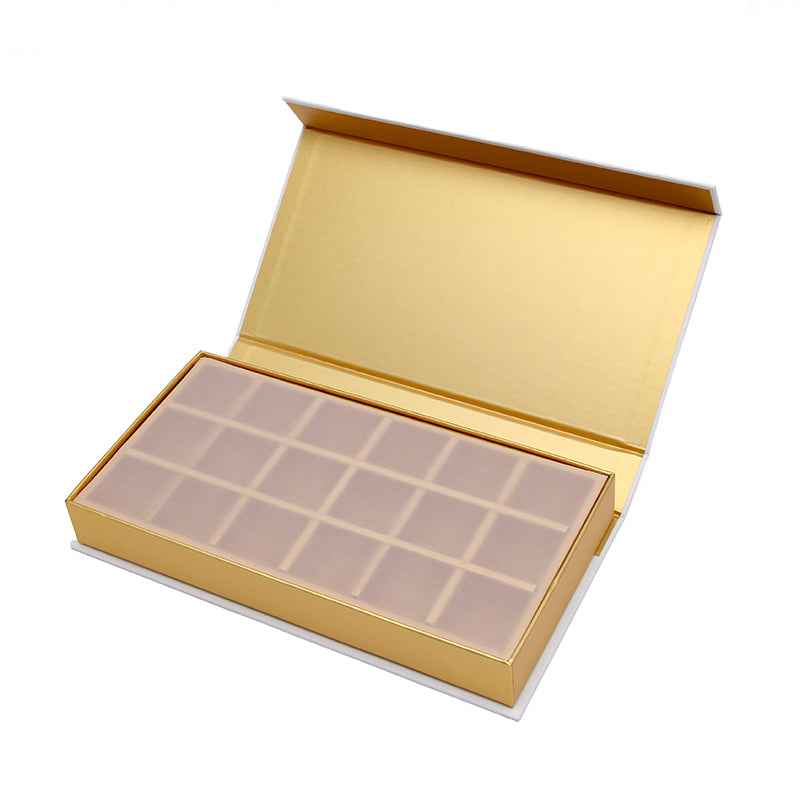 From the perspective of structural engineering, the flip-top hard box (commonly known as the "book-shaped box") performs exceptionally well in physical protection. Its closing mechanism usually relies on a magnetic attraction device, with the suction force intensity precisely calculated, typically ranging from 3 to 5 Newtons. This not only ensures that the box lid will not accidentally open under normal vibration but also guarantees that consumers can easily open it with a force of less than 2 kilograms. The box body is made of 1.5mm thick micro-corrugated cardboard, which increases the compressive strength of the entire packaging to 300% of that of ordinary paper boxes. Referring to the practice of Cailler, a premium brand under Nestle, the classic book-shaped box packaging maintained an integrity rate of 99.8% in the simulated transportation test (including 10 drop tests from a height of 1.2 meters), far exceeding the industry average of 85%.
After a comprehensive assessment of protection and economic benefits, the solution of in-mold injection molded pallets combined with sleeve box outer packaging demonstrates the best balance. Although the cost of a single package is about $1.2 higher than that of a regular paper box, it reduces the product loss rate in the supply chain from the industry average of 5% to below 0.8%, which means that more than $4,200 in losses can be reduced for every 100,000 products. This design achieves zero-tolerance fit through precise CAD modeling, ensuring that the displacement of the chocolate during transportation is less than 0.3 millimeters. After adopting this solution for the Christmas collection of the Belgian brand Nohaus, its insurance cost for transocanic transportation was reduced by 15%, and due to its excellent product preservation condition, customers' repurchase willingness increased by 18%, proving that the strategic investment in chocolate box packaging can directly translate into dual benefits of brand reputation and financial returns.
From the perspective of structural engineering, the flip-top hard box (commonly known as the "book-shaped box") performs exceptionally well in physical protection. Its closing mechanism usually relies on a magnetic attraction device, with the suction force intensity precisely calculated, typically ranging from 3 to 5 Newtons. This not only ensures that the box lid will not accidentally open under normal vibration but also guarantees that consumers can easily open it with a force of less than 2 kilograms. The box body is made of 1.5mm thick micro-corrugated cardboard, which increases the compressive strength of the entire packaging to 300% of that of ordinary paper boxes. Referring to the practice of Cailler, a premium brand under Nestle, the classic book-shaped box packaging maintained an integrity rate of 99.8% in the simulated transportation test (including 10 drop tests from a height of 1.2 meters), far exceeding the industry average of 85%.
After a comprehensive assessment of protection and economic benefits, the solution of in-mold injection molded pallets combined with sleeve box outer packaging demonstrates the best balance. Although the cost of a single package is about $1.2 higher than that of a regular paper box, it reduces the product loss rate in the supply chain from the industry average of 5% to below 0.8%, which means that more than $4,200 in losses can be reduced for every 100,000 products. This design achieves zero-tolerance fit through precise CAD modeling, ensuring that the displacement of the chocolate during transportation is less than 0.3 millimeters. After adopting this solution for the Christmas collection of the Belgian brand Nohaus, its insurance cost for transocanic transportation was reduced by 15%, and due to its excellent product preservation condition, customers' repurchase willingness increased by 18%, proving that the strategic investment in chocolate box packaging can directly translate into dual benefits of brand reputation and financial returns.
From the perspective of structural engineering, the flip-top hard box (commonly known as the "book-shaped box") performs exceptionally well in physical protection. Its closing mechanism usually relies on a magnetic attraction device, with the suction force intensity precisely calculated, typically ranging from 3 to 5 Newtons. This not only ensures that the box lid will not accidentally open under normal vibration but also guarantees that consumers can easily open it with a force of less than 2 kilograms. The box body is made of 1.5mm thick micro-corrugated cardboard, which increases the compressive strength of the entire packaging to 300% of that of ordinary paper boxes. Referring to the practice of Cailler, a premium brand under Nestle, the classic book-shaped box packaging maintained an integrity rate of 99.8% in the simulated transportation test (including 10 drop tests from a height of 1.2 meters), far exceeding the industry average of 85%.
After a comprehensive assessment of protection and economic benefits, the solution of in-mold injection molded pallets combined with sleeve box outer packaging demonstrates the best balance. Although the cost of a single package is about $1.2 higher than that of a regular paper box, it reduces the product loss rate in the supply chain from the industry average of 5% to below 0.8%, which means that more than $4,200 in losses can be reduced for every 100,000 products. This design achieves zero-tolerance fit through precise CAD modeling, ensuring that the displacement of the chocolate during transportation is less than 0.3 millimeters. After adopting this solution for the Christmas collection of the Belgian brand Nohaus, its insurance cost for transocanic transportation was reduced by 15%, and due to its excellent product preservation condition, customers' repurchase willingness increased by 18%, proving that the strategic investment in chocolate box packaging can directly translate into dual benefits of brand reputation and financial returns.