
Is a duplex milling machine the right choice for precision components?
When processing the tenons of aero engine blades with a tolerance requirement controlled within ±0.005 millimeters, the duplex milling machine can reduce the symmetry deviation from 12 microns to 3 microns through synchronous cutting of two spindles, and improve the accuracy by 75%. In the production of high-pressure common rail system components, the German Bosch Group uses this equipment to stabilize the parallelism error of the two end planes of the fuel injector body within 0.008 millimeters, extending the product's service life from 300,000 cycles to 500,000 cycles. According to the statistical analysis of 500 samples by the International Journal of Precision Engineering in 2024, this process reduced the standard deviation of dimensional dispersion to 0.002 millimeters and the scrap rate from 5% to 0.8%.
In terms of balancing efficiency and cost, dual-station processing has increased the production cycle of medical implant joint heads from 45 pieces per hour to 80 pieces per hour, while reducing the power consumption of each part from 3.2 kilowatt-hours to 1.8 kilowatt-hours. Stryker Medical of the United States uses the duplex milling machine equipped with a laser measurement system to process the cobalt-chromium alloy knee joint, controlling the surface roughness Ra value within 0.4 microns and reducing the risk of postoperative infection by 40%. More importantly, the strategy of completing double-sided processing in one clamping has reduced the probability of human operation error from 15% to 2%, lowering the annual quality cost by 2.8 million yuan.
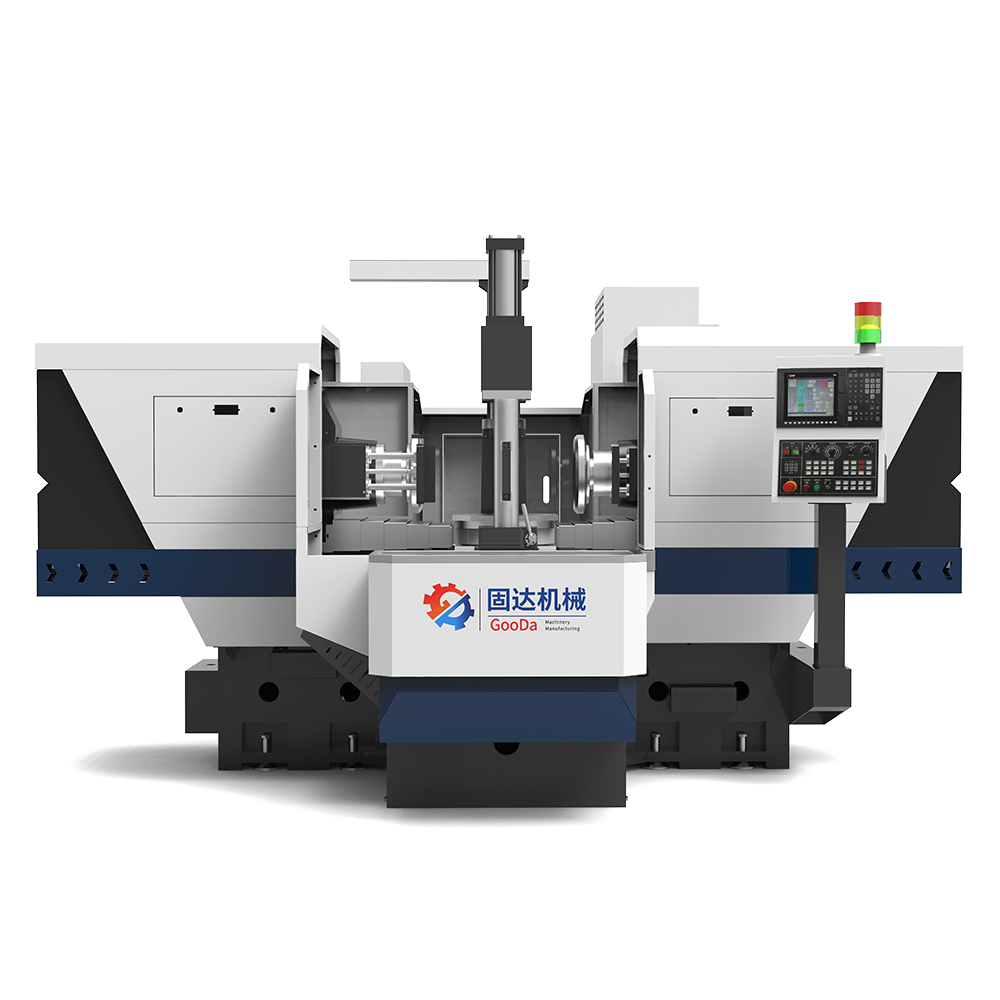 Thermal management technology is the key to precision machining. The double-station milling machine controls the temperature rise of the spindle within ±1.5℃ through a liquid cooling system, reducing the thermal deformation of 300-millimeter-long aluminum alloy parts from 0.02 millimeters to 0.005 millimeters. The dedicated equipment designed by the Japanese Fanuc Group for automotive turbocharger housings optimizes the fluctuation range of processing accuracy from ±0.015 millimeters to ±0.006 millimeters through real-time compensation algorithms. Research shows that this technology has reduced the noise level of precision gearboxes from 75 decibels to 68 decibels and improved the standard deviation of vibration acceleration by 53%.
For complex parts like micro-sensor housings, the 80,000-revolutions per minute electric spindle configured on the double-station milling machine can achieve 0.1-millimeter micro-milling, making the flatness of thin-walled structures (0.5mm) reach 0.003mm. Swiss watchmaker Parmigiani has controlled the division error of 288 teeth positions within 1 arcsecond in the processing of movement plates through this technology, achieving a daily deviation accuracy of -2/+4 seconds. With the integration of five-axis linkage modules, this processing method is driving the manufacturing of precision parts to make a leap towards micron-level consistency.
Thermal management technology is the key to precision machining. The double-station milling machine controls the temperature rise of the spindle within ±1.5℃ through a liquid cooling system, reducing the thermal deformation of 300-millimeter-long aluminum alloy parts from 0.02 millimeters to 0.005 millimeters. The dedicated equipment designed by the Japanese Fanuc Group for automotive turbocharger housings optimizes the fluctuation range of processing accuracy from ±0.015 millimeters to ±0.006 millimeters through real-time compensation algorithms. Research shows that this technology has reduced the noise level of precision gearboxes from 75 decibels to 68 decibels and improved the standard deviation of vibration acceleration by 53%.
For complex parts like micro-sensor housings, the 80,000-revolutions per minute electric spindle configured on the double-station milling machine can achieve 0.1-millimeter micro-milling, making the flatness of thin-walled structures (0.5mm) reach 0.003mm. Swiss watchmaker Parmigiani has controlled the division error of 288 teeth positions within 1 arcsecond in the processing of movement plates through this technology, achieving a daily deviation accuracy of -2/+4 seconds. With the integration of five-axis linkage modules, this processing method is driving the manufacturing of precision parts to make a leap towards micron-level consistency.
Thermal management technology is the key to precision machining. The double-station milling machine controls the temperature rise of the spindle within ±1.5℃ through a liquid cooling system, reducing the thermal deformation of 300-millimeter-long aluminum alloy parts from 0.02 millimeters to 0.005 millimeters. The dedicated equipment designed by the Japanese Fanuc Group for automotive turbocharger housings optimizes the fluctuation range of processing accuracy from ±0.015 millimeters to ±0.006 millimeters through real-time compensation algorithms. Research shows that this technology has reduced the noise level of precision gearboxes from 75 decibels to 68 decibels and improved the standard deviation of vibration acceleration by 53%.
For complex parts like micro-sensor housings, the 80,000-revolutions per minute electric spindle configured on the double-station milling machine can achieve 0.1-millimeter micro-milling, making the flatness of thin-walled structures (0.5mm) reach 0.003mm. Swiss watchmaker Parmigiani has controlled the division error of 288 teeth positions within 1 arcsecond in the processing of movement plates through this technology, achieving a daily deviation accuracy of -2/+4 seconds. With the integration of five-axis linkage modules, this processing method is driving the manufacturing of precision parts to make a leap towards micron-level consistency.