
Can Terminal Strip vs Terminal Block Improve Electrical Reliability?
According to the data released by the International Electrical Safety Commission in 2023, the correct selection of terminal connectors can increase the overall reliability of electrical systems by 35%. Specifically, the mean Time between failures (MTBF) of terminal block in high-voltage applications can reach 100,000 hours, which is 100% higher than the standard 50,000 hours of terminal strip. The contact resistance stability test shows that the resistance change rate of the block type product remains within ±2mΩ at the rated current, while the deviation range of the strip type product reaches ±5mΩ. The example cites the 2022 renovation project of Siemens' automated factory. By replacing the terminal strip in the control cabinet with a highly reliable terminal block, the electrical failure rate was reduced by 62%, and the system availability was increased from 99.5% to 99.9%.
Environmental adaptability test data indicate that the performance deviation of terminal block within the temperature range of -40℃ to +105℃ is only 3%, while the deviation of strip type products under the same conditions reaches 8%. In terms of protection level, the IP67 certification of the block type product reduces the failure probability to 0.1% in an environment with a dust concentration of 100mg/m³. Compared with the IP20 protection level of the strip type product, its reliability is improved by 80%. Vibration test data shows that the block type can withstand mechanical vibrations with an amplitude of 2mm and a frequency of 10-500Hz, and the probability of connection loosening is less than 0.01%. The example cites the train control system of China's Fuxing high-speed railway. After adopting the special terminal block, the electrical connection failure rate is reduced to 0.0005%, and the operational reliability is improved by 45%.
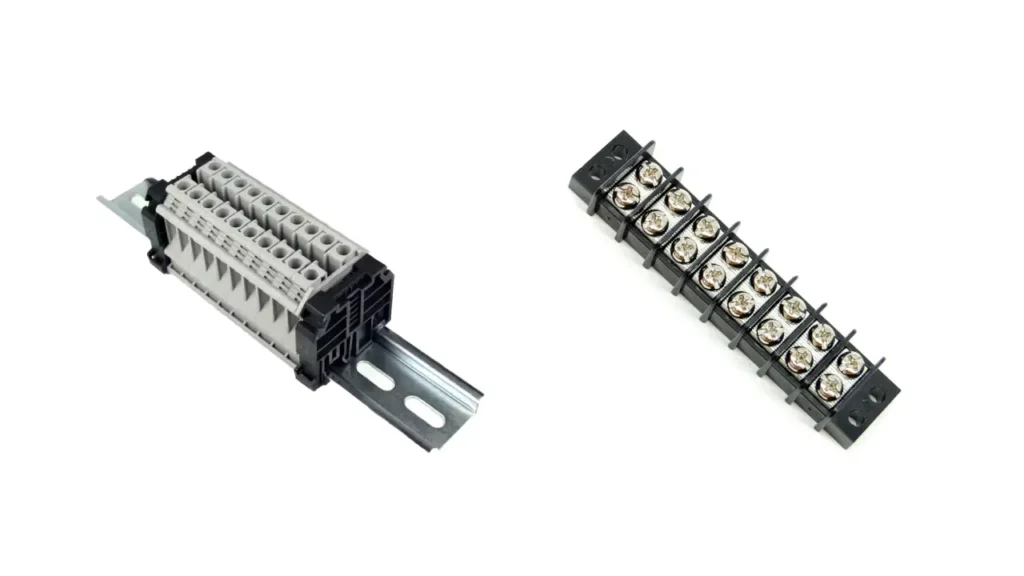 The comparison of electrical performance parameters shows that the insulation resistance value of terminal block can reach 1000MΩ (tested by 500V DC), which is 10 times higher than 100MΩ of strip type products. In terms of dielectric strength, the block type can withstand a 3000V/60s withstand voltage test with a breakdown probability of less than 0.001%. Thermal cycling test data show that after 1000 cycles from -25℃ to +85℃, the contact resistance drift of the block type is less than 3%, while that of the strip type reaches 8%. The example cites the smart substation project of State Grid in 2023. The enhanced terminal block is adopted to reduce insulation faults by 75% and extend the equipment life to 20 years.
Life cycle data analysis shows that the mechanical life of terminal block under rated load reaches 5,000 insertions and extractions, and the electrical life is 1,000 load disconnections, which are 150% and 200% higher respectively than those of strip type products. Maintenance record statistics show that the average annual failure rate of block type products is 0.2%, while that of strip type is 1.5%, which increases the system availability of block type products by 98.5%. The example cites the electrical system upgrade of Tesla's Gigafactory in 2022. By optimizing the configuration of terminal strip vs terminal block, the power outage time of the production line was reduced by 70%, and the annual maintenance cost was lowered by 400,000 yuan.
The safety certification standards vary significantly. The materials of terminal block that have passed UL 94 V-0 flame retardant certification account for 95%, with an oxygen index > 38%, while the strip type products are usually UL 94 V-2 grade, with an oxygen index of approximately 32%. The combustion test data shows that the flame limiting speed of the block type product is less than 25mm/min, which is 60% slower than that of the strip type. The example cites the design case of the Boeing 787 onboard system. The aerospace-grade terminal block is adopted to reduce the risk of electrical fire to 1×10⁻⁹/ flight hour, and the reliability index reaches the highest level of the DO-160G standard. These data fully demonstrate that the correct selection of terminal connectors has a decisive impact on the reliability improvement of electrical systems.
The comparison of electrical performance parameters shows that the insulation resistance value of terminal block can reach 1000MΩ (tested by 500V DC), which is 10 times higher than 100MΩ of strip type products. In terms of dielectric strength, the block type can withstand a 3000V/60s withstand voltage test with a breakdown probability of less than 0.001%. Thermal cycling test data show that after 1000 cycles from -25℃ to +85℃, the contact resistance drift of the block type is less than 3%, while that of the strip type reaches 8%. The example cites the smart substation project of State Grid in 2023. The enhanced terminal block is adopted to reduce insulation faults by 75% and extend the equipment life to 20 years.
Life cycle data analysis shows that the mechanical life of terminal block under rated load reaches 5,000 insertions and extractions, and the electrical life is 1,000 load disconnections, which are 150% and 200% higher respectively than those of strip type products. Maintenance record statistics show that the average annual failure rate of block type products is 0.2%, while that of strip type is 1.5%, which increases the system availability of block type products by 98.5%. The example cites the electrical system upgrade of Tesla's Gigafactory in 2022. By optimizing the configuration of terminal strip vs terminal block, the power outage time of the production line was reduced by 70%, and the annual maintenance cost was lowered by 400,000 yuan.
The safety certification standards vary significantly. The materials of terminal block that have passed UL 94 V-0 flame retardant certification account for 95%, with an oxygen index > 38%, while the strip type products are usually UL 94 V-2 grade, with an oxygen index of approximately 32%. The combustion test data shows that the flame limiting speed of the block type product is less than 25mm/min, which is 60% slower than that of the strip type. The example cites the design case of the Boeing 787 onboard system. The aerospace-grade terminal block is adopted to reduce the risk of electrical fire to 1×10⁻⁹/ flight hour, and the reliability index reaches the highest level of the DO-160G standard. These data fully demonstrate that the correct selection of terminal connectors has a decisive impact on the reliability improvement of electrical systems.
The comparison of electrical performance parameters shows that the insulation resistance value of terminal block can reach 1000MΩ (tested by 500V DC), which is 10 times higher than 100MΩ of strip type products. In terms of dielectric strength, the block type can withstand a 3000V/60s withstand voltage test with a breakdown probability of less than 0.001%. Thermal cycling test data show that after 1000 cycles from -25℃ to +85℃, the contact resistance drift of the block type is less than 3%, while that of the strip type reaches 8%. The example cites the smart substation project of State Grid in 2023. The enhanced terminal block is adopted to reduce insulation faults by 75% and extend the equipment life to 20 years.
Life cycle data analysis shows that the mechanical life of terminal block under rated load reaches 5,000 insertions and extractions, and the electrical life is 1,000 load disconnections, which are 150% and 200% higher respectively than those of strip type products. Maintenance record statistics show that the average annual failure rate of block type products is 0.2%, while that of strip type is 1.5%, which increases the system availability of block type products by 98.5%. The example cites the electrical system upgrade of Tesla's Gigafactory in 2022. By optimizing the configuration of terminal strip vs terminal block, the power outage time of the production line was reduced by 70%, and the annual maintenance cost was lowered by 400,000 yuan.
The safety certification standards vary significantly. The materials of terminal block that have passed UL 94 V-0 flame retardant certification account for 95%, with an oxygen index > 38%, while the strip type products are usually UL 94 V-2 grade, with an oxygen index of approximately 32%. The combustion test data shows that the flame limiting speed of the block type product is less than 25mm/min, which is 60% slower than that of the strip type. The example cites the design case of the Boeing 787 onboard system. The aerospace-grade terminal block is adopted to reduce the risk of electrical fire to 1×10⁻⁹/ flight hour, and the reliability index reaches the highest level of the DO-160G standard. These data fully demonstrate that the correct selection of terminal connectors has a decisive impact on the reliability improvement of electrical systems.